
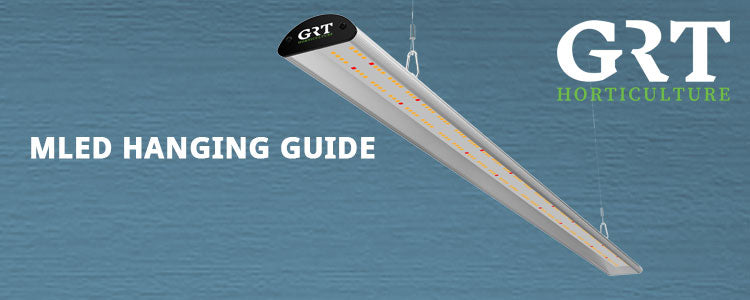
How high should your MLED-150s be? For a single GRT Horticulture MLED-150 LED bar, the A-Grade team recommends hanging it 40–60cm above the canopy in vegetative growth and 15–30cm in flowering. This short guide explains why, using PPFD readings we took directly under the light.
This guide covers the MLED-150's design, how its light spreads, recommended hanging heights, PPFD readings at each distance, how many bars you need to fill a 1.2 x 1.2m space and common hanging problems.
💡 Introducing the GRT Horticulture MLED-150
The MLED-150 is an LED lighting bar made by GRT Horticulture. It uses Samsung LM301H diodes in 3000K, with additional 660nm red diodes, giving a spectrum designed for flowering and fruiting. In our experience, the balanced ratio of red to blue light has produced excellent flowering results.
It runs on a 150W MeanWell driver and comes with extension cables, so you can mount the driver on the fixture or away from the light.
The MLED-150 is part of a modular system. Rather than one fixed panel, you add bars and set their spacing to spread light evenly across your room, which is one of the biggest advantages of the design.
📏 How the MLED-150 spreads light
A single MLED-150 projects a strong band of light about 1.2m long and roughly 30cm wide. The 30cm either side of that band receives about half the intensity. Spacing two bars about 60cm apart overlaps those weaker edges, giving a fairly even spread over roughly 1.2 x 0.9m for vegetative growth.
Because the diodes are spread out, intensity at any single point is lower than with a compact quantum board. That means less risk of light stress and lets you hang the bars closer to the canopy, while adding more bars still delivers high total light. You can also hang each bar at a different height or angle to fine-tune spread and intensity.
⚙️ Hanging height recommendations for a single MLED-150
- Vegetative growth: 40–60cm from the canopy (about 290–460 µmol/m²/s directly under the light)
- Flowering: 15–30cm from the canopy (about 560–850 µmol/m²/s directly under the light)
PPFD directly under a single MLED-150
| Distance from canopy | PPFD (µmol/m²/s) | Best for |
|---|---|---|
| 15cm | 850 | Flowering |
| 20cm | 750 | Flowering |
| 30cm | 560 | Flowering or late veg |
| 40cm | 460 | Vegetative growth |
| 50cm | 340 | Vegetative growth |
| 60cm | 290 | Early vegetative growth |
These readings were taken by the A-Grade team directly under one bar; readings at the edges will be lower.
🌱 Filling a 1.2 x 1.2m grow space
To light a common 1.2 x 1.2m space for flowering, use four MLED-150s spaced evenly across the room. At 20cm from the canopy, that gives roughly 800–850 µmol/m²/s from wall to wall, which in our experience is about as much as most fruiting and flowering plants can use on a 12-hour light cycle before showing stress.
For vegetative growth with the same setup, hang the bars 40–50cm from the canopy for an even 340–460 µmol/m²/s. In late veg, you can lower them to 30–40cm for faster growth.
💡 A-Grade Tip: Lower your bars in steps of 5–10cm over several days rather than all at once, and check the top leaves after each change for curling or bleaching.
⚠️ Common hanging height problems and fixes
| Problem | Likely cause | Status | Fix |
|---|---|---|---|
| Bleached or curled top leaves | Bars hung too close | Common | Raise bars 5–10cm and reassess |
| Stretched plants in veg | Bars too high | Common | Lower to 40–50cm from the canopy |
| Weaker growth between bars | Bars spaced too far apart | Occasional | Space bars evenly so their edges overlap |
| Uneven canopy height | All bars at one height over uneven plants | Occasional | Adjust each bar's height to its section of canopy |
📝 Key takeaways for MLED-150 hanging heights
Hang a single MLED-150 40–60cm above the canopy in veg and 15–30cm in flower, and use four evenly spaced bars to fill a 1.2 x 1.2m space at around 800–850 µmol/m²/s for flowering. The modular design lets you fine-tune spread and intensity bar by bar.
For general guidance on any LED, see how far LED grow lights should be from plants, or browse our current LED grow lights and controllers.