

Can any LED light be used as a grow light? Not effectively. A standard household LED bulb will keep a plant alive, but it won’t deliver the light intensity or spectrum needed for strong photosynthesis, vigorous growth or reliable flowering.
Photosynthesis depends on plants absorbing specific wavelengths of light — mostly in the red and blue range — to convert light energy into chemical energy. Horticultural LED grow lights are engineered specifically for this job, while household LEDs are designed for human eyesight and comfort rather than plant growth.
This guide breaks down the real differences between standard and horticultural LEDs, and how to choose a grow light that actually supports hydroponic growing indoors, where plants have no access to natural sunlight. If you’re just getting your setup together, our guide to The Four Key Elements A Hydroponic System Needs To Succeed covers lighting alongside the other essentials.
💡 The Difference Between Standard LED Lights and LED Grow Lights
Standard LED lights are designed around lumens — a measure of how bright a light appears to the human eye. Plants don’t perceive light the way we do, and lumens don’t account for the wavelengths that actually drive photosynthesis.
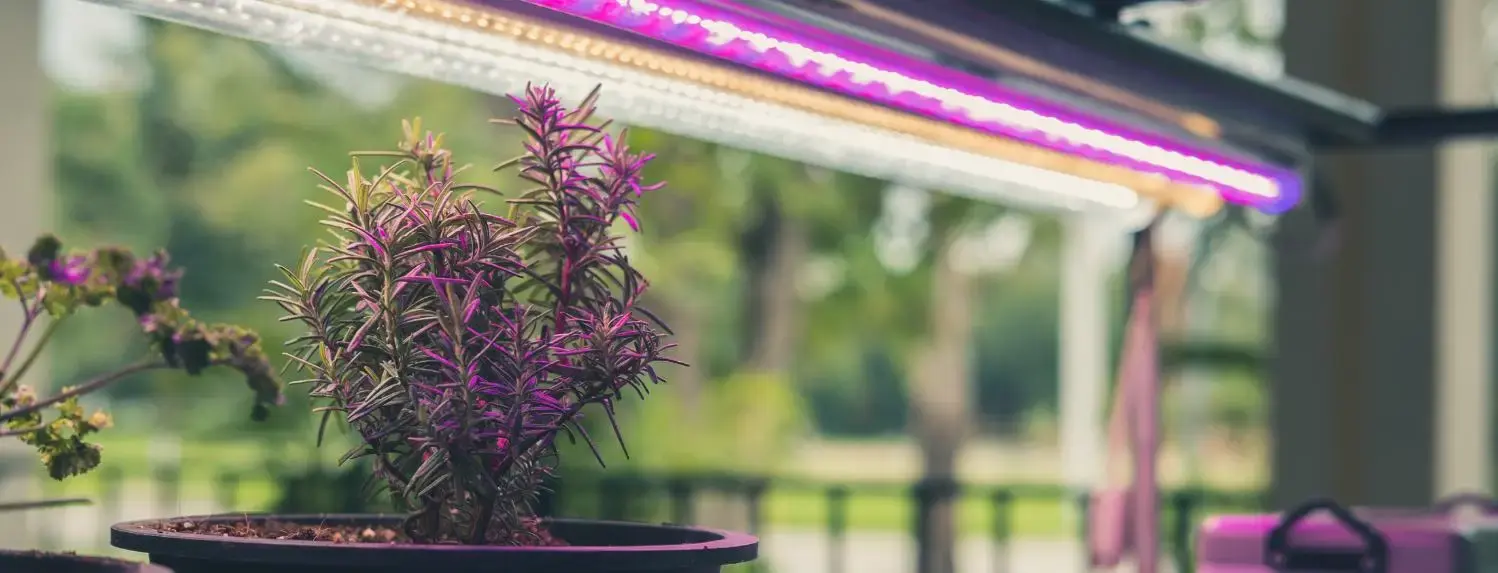
LED grow lights are engineered to emit more of the light plants use most efficiently: the blue (roughly 400–500nm) and red (roughly 600–700nm) portions of the spectrum, known collectively as Photosynthetically Active Radiation (PAR). Blue light supports vegetative growth, leaf development and compact plant structure, while red light drives flowering, fruiting and overall productivity.
A standard bulb can technically keep a plant alive at close range, but the mismatch in intensity and spectrum means growth is usually slow, leggy and unproductive compared with a plant grown under a proper horticultural LED.
Why Plants Respond to Red and Blue Light
Chlorophyll, the pigment plants use to capture light for photosynthesis, absorbs red and blue wavelengths most efficiently and reflects green light — which is part of why healthy foliage looks green. Grow lights are tuned to lean into red and blue output for this reason, rather than spreading energy evenly across the visible spectrum.
Why PPFD Matters More Than Lumens
Lumens measure how bright a light looks to the human eye and don’t reflect the wavelengths plants actually use, according to guidance from the University of Minnesota Extension on indoor plant lighting. A more useful measurement for growers is PPFD (Photosynthetic Photon Flux Density), which measures the amount of plant-usable light reaching a leaf surface, expressed in µmol/m²/s.
Oklahoma State University Extension recommends a PPFD of roughly 400–800 µmol/m²/s for strong plant growth, though the ideal figure varies by crop, growth stage and how far the light sits from the canopy.
📏 Standard LED vs LED Grow Light: Specs Compared
The table below compares a typical household LED bulb with a horticultural LED grow light bulb.
| Spec | Standard Household LED | LED Grow Light Bulb |
|---|---|---|
| Wattage | 4.6W | 15W |
| Lumens Output | 430lm | 1600lm |
| Spectrum | 3000K | Full-Spectrum GB4800K |
| Average Life Hours | 15,000 | 50,000+ |
A quality LED grow light produces close to four times the light output of a standard bulb and typically lasts more than three times longer — over 50,000 hours, which works out to more than 5.7 years of continuous 24-hour use.
💡 A-Grade Tip: Lumens are fine for comparing bulbs at a glance, but always check for a PPFD or spectrum chart on the product listing before buying — it’s a far more reliable indicator of how well a light will perform for photosynthesis.
🌱 Benefits of LED Grow Lights for Hydroponic Growing
Compared with older HID and fluorescent lighting, horticultural LED grow lights offer several practical advantages for hydroponic and indoor growers:
- Lower power consumption for the same or greater usable light output
- Higher light intensity for faster plant growth
- Full-spectrum coverage suited to seedling, vegetative and flowering stages
- Reduced heat output for easier climate control
- Longer operating life and fewer bulb replacements
- Stronger, more consistent yields
Because LED grow lights run cooler than HID lighting, they help maintain stable temperature and humidity in a hydroponic grow room — both of which directly affect plant performance and nutrient uptake.
LED fixtures are also easy to pair with a timer to control photoperiod. Daily Light Integral (DLI) — the total amount of light a plant receives over a full day — is a useful concept here. If you’re deciding on a photoperiod schedule, see our guide on Whether You Should Turn Your Grow Lights Off At Night.
⚙️ Choosing the Right Grow Light for Your Setup
Before buying a grow light, weigh up:
- Spectrum: full-spectrum lights suit all growth stages; some growers prefer separate veg and bloom spectrums
- PPFD and coverage area: match light intensity and footprint to your tent or grow space
- Heat output: lower heat means less demand on ventilation and cooling
- Energy efficiency: compare efficacy (µmol/J) where it's published, not just wattage
- Growth stage: seedlings need lower intensity than flowering plants
Undersized lighting is one of the most common reasons for slow growth in a hydroponic setup, so it's worth matching a light's rated coverage area to your actual tent or shelf dimensions rather than guessing. For a closer look at spectrum, wattage and coverage together, see our guide on What The Best LED Light To Grow With Actually Is.
🔌 Retrofitting Existing Fixtures
You don’t always need a dedicated grow light fixture to add horticultural lighting to a space. For the dark corners of your home, the Treegers LED Grow Bulbs are designed to fit any standard E27 lamp socket, making it easy to add full-spectrum plant lighting to floor lamps, desk lamps or pendant fixtures without rewiring anything.
💡 A-Grade Tip: If you only need to light a small area — a shelf, a propagation tray or a single houseplant — a screw-in LED grow bulb is usually a simpler and cheaper starting point than a full panel fixture.
All Your Hydroponic Lighting Needs in One Place
A-Grade Hydroponics has supplied hydroponic equipment in Melbourne since 2013. Alongside LED grow lights, we stock grow tents, hydroponic systems, ventilation equipment and environmental control products to help you get the most out of an indoor growing setup.
Once your lighting is sorted, our Guide To Beginner-Friendly Plants For An Indoor Hydroponic Garden is a good next stop, or check our Hydroponics FAQ if you’ve still got questions.
Browse our full range of LED grow lights online, or visit our Cheltenham store to talk through the right setup for your space.