

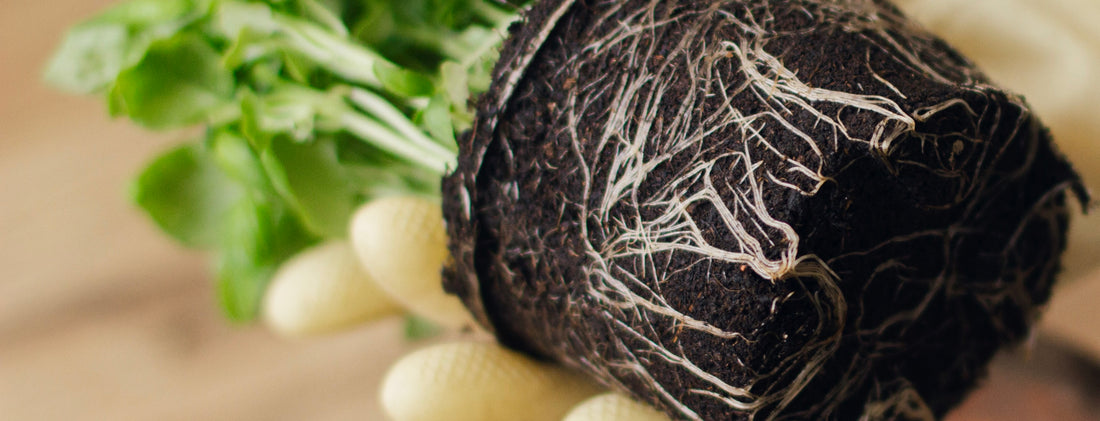
Mycorrhiza is a partnership between beneficial fungi and plant roots, where the plant feeds the fungus sugars and the fungus extends the root system to bring back water and nutrients, especially phosphorus. Endomycorrhizae, the type that grows inside root cells, partner with most crop plants, which makes them the type most growers look for in a root inoculant.
This guide covers what mycorrhiza is, the difference between endomycorrhizae and ectomycorrhizae, the main types of mycorrhizal fungi, the benefits for your plants, how to use mycorrhizae step by step and common problems and fixes.
🍄 What is mycorrhiza?
The word mycorrhiza means "fungus root". It describes a mutually beneficial (symbiotic) relationship: the plant supplies carbohydrates made through photosynthesis, and the fungus spreads fine threads called hyphae through the growing media, reaching water and nutrients the roots can't access on their own.
These partnerships are ancient and widespread. Most land plant species, probably 70–80%, can form associations with arbuscular mycorrhizal fungi, the most common type of endomycorrhizae.
🔬 Endomycorrhizae vs ectomycorrhizae
Mycorrhizal fungi are usually split into two broad groups:
- Endomycorrhizae: the fungal threads penetrate the cell walls of the root and form structures inside root cells
- Ectomycorrhizae: the fungus wraps around the outside of the root and grows between root cells, without entering them
Ectomycorrhizae mostly partner with trees such as pines and oaks. Endomycorrhizae partner with most vegetables, herbs, flowers and other crops, so they're the type that matters for most indoor and hydroponic gardens.
🧬 The main types of mycorrhizal fungi
- Arbuscular: the most common type. The fungus forms tree-like structures called arbuscules inside root cells, where nutrients are exchanged with the plant
- Ericoid: found in heathers, blueberries and related plants, where the fungus forms coils inside root cells
- Orchid: essential for orchids, whose tiny seeds rely on the fungus for energy to germinate
- Arbutoid and monotropoid: specialised types found in certain plants of the heath family, including some that have no chlorophyll at all
🌱 Benefits of mycorrhizae for your plants
- Better uptake of phosphorus and other nutrients
- Improved water uptake and drought tolerance
- More resilient, healthier root systems
- Better structure in coco and soil, as fungal threads help bind media particles together
Results vary between plants and fungal species. Mycorrhizae can't replace good nutrition, but they can help plants use what's there more efficiently.
🪴 How to use mycorrhizae, step by step
1. Inoculate early
Apply mycorrhizae at sowing, cloning or transplanting, so the fungus is in contact with young roots from the start.
2. Put it where the roots are
Dust or drench the inoculant directly onto the roots or into the planting hole, following the label rate.
3. Go easy on phosphorus early on
High-phosphorus feeding can greatly reduce how much of the root system the fungus colonises. Avoid heavy phosphorus boosters in the first few weeks after inoculating.
4. Keep fungicides away from the root zone
Fungicides and sterilising additives can kill beneficial fungi too, so avoid using them in the same root zone.
💡 A-Grade Tip: Mycorrhizae are most useful in inert media like coco coir, which starts out with very little microbial life. A dose at transplant gives the roots a head start.
⚠️ Common mycorrhizae problems and fixes
| Problem | Likely cause | Status | Fix |
|---|---|---|---|
| No visible benefit | Heavy phosphorus feeding limiting colonisation | Common | Reduce phosphorus boosters in early growth |
| No benefit on cabbage, kale or broccoli | Brassicas don't form mycorrhizal partnerships | Expected | Don't use mycorrhizae on brassica crops |
| Inoculant seems to stop working | Fungicide or steriliser in the root zone | Avoidable | Keep fungicides away from inoculated roots |
| Poor colonisation | Applied after roots were established | Common | Apply at sowing, cloning or transplant |
📝 Key takeaways for mycorrhiza and endomycorrhizae
Endomycorrhizae partner with most crop plants, extending the root system to improve water and nutrient uptake, especially phosphorus. Apply them early, put them in contact with roots, go easy on phosphorus and keep fungicides away.
Browse A-Grade Hydroponics' hydroponic nutrient and additive range, or get in touch with the team if you've got questions about your own setup.
📚 References
- ScienceDirect Topics, Mycorrhizal fungi. https://www.sciencedirect.com/topics/agricultural-and-biological-sciences/mycorrhizal-fungi
- Smith, Jakobsen, Grønlund and Smith, Roles of arbuscular mycorrhizas in plant phosphorus nutrition, Plant Physiology, 2011. https://pmc.ncbi.nlm.nih.gov/articles/PMC3135927