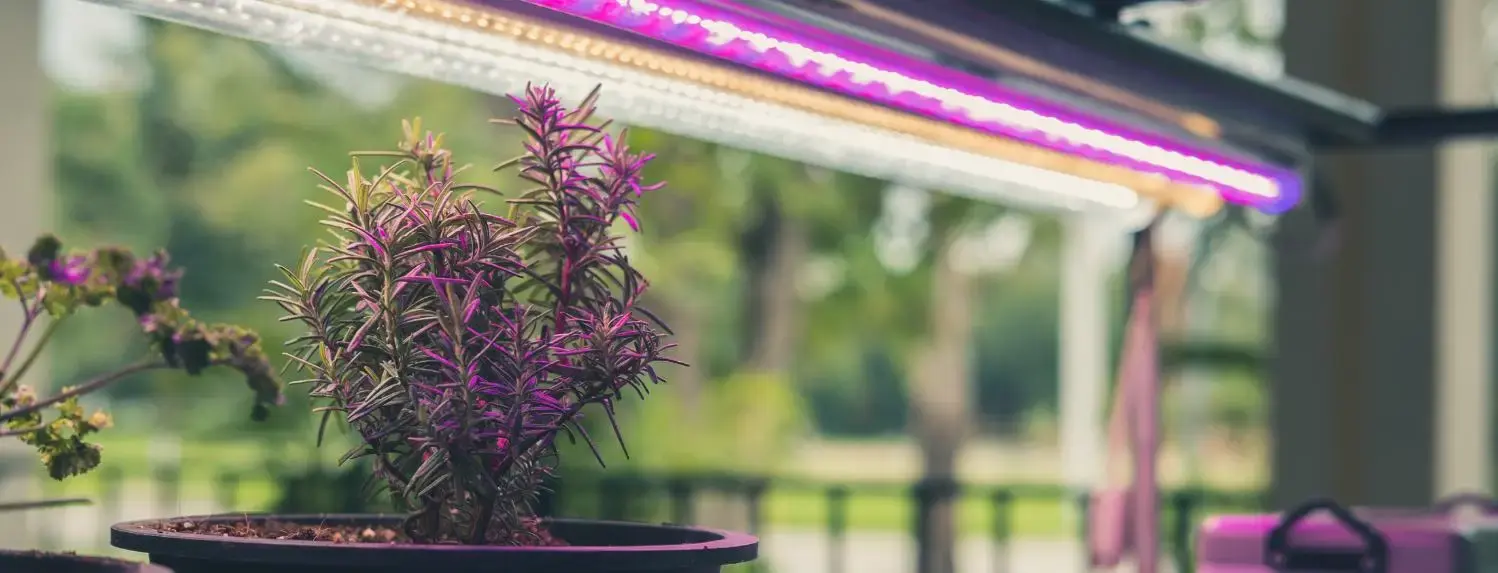


Understanding LED grow lights means getting comfortable with a handful of terms that describe how light is measured and how plants respond to it. This glossary covers the lighting terminology you'll see on grow light spec sheets — PPF, PPFD and DLI — alongside the botany that explains why photoperiod (day length) matters so much for flowering. Most growers now run LED lighting in their hydroponic tents and grow rooms, so understanding these terms helps you get more out of whatever fixture you're using.
💡 Lighting Glossary: PPF, PPFD and DLI
PPF (Photosynthetic Photon Flux) is the total quantity of light photons a grow light produces every second, measured in µmol/s. PPF is a fixed property of the fixture itself — it doesn't change depending on where you measure it, because it describes total output, not output at a specific point.
PPFD (Photosynthetic Photon Flux Density) is different: it's the density of those photons landing on a specific area of your plant canopy, measured in µmol/m²/s. Unlike PPF, PPFD does change with distance — the same total light output spreads over a smaller area the closer your canopy sits to the fixture, so PPFD readings increase as you move a light meter closer to the light source.
DLI (Daily Light Integral) is the total accumulation of light your plants receive across a full day, combining PPFD and photoperiod length. It's measured in mol/m²/d (moles of photons per square metre per day).
💡 A-Grade Tip: All three of these — PPF, PPFD and DLI — can be measured with a quantum light meter placed at canopy height. From a PPFD reading and your photoperiod, you can calculate DLI using the standard conversion formula.
🌿 Phytochrome: How Plants Sense Light
Phytochrome is a light-sensing pigment found in plants, some bacteria and some fungi. It exists in two interconvertible forms, Pr and Pfr, and its job is to tell the plant what time of day — and what season — it is, based on the ratio of red to far-red light present.
Pr is the inactive form. It absorbs red light (roughly 600–700nm, with peak absorption around 660nm) and converts rapidly to the active Pfr form.
Pfr is the active form. It absorbs far-red light (roughly 700–800nm, with peak absorption around 730nm) and converts back to the inactive Pr form.
Sunlight is rich in red light and comparatively low in far-red light, which is why Pfr accumulates through the day. At night, without light to trigger the reverse conversion, Pfr slowly decays back to Pr on its own — and it's the length of that dark period that lets the plant judge how long the night has been.
🌑 What Is a Photoperiod?
A photoperiod is simply the length of daily light an organism receives. Plants that respond to this cue fall broadly into short-day and long-day categories, based on whether they flower once night length exceeds or falls below a critical threshold.
🌱 Short-Day Plants and Flowering
Short-day plants include rice, soybean and cannabis, among many others — each species has its own specific critical night length, so this isn't a single fixed rule across all of them. In these plants, high Pfr levels inhibit flowering. During spring and summer, short nights don't give Pfr enough time to fully decay, so flowering doesn't start. As nights lengthen into autumn and winter, Pfr has time to decay back to Pr, and flowering is triggered.
Indoors, growers replicate this with lighting schedules rather than waiting for the seasons. A common vegetative photoperiod is 18 hours of light and 6 hours of darkness; switching to 12 hours on and 12 hours off gives short-day plants long enough nights to trigger flowering.
Daily light integral is also relevant here: most short-day crops have an upper limit to how much light they can productively use in a day, commonly cited in the 25–45 mol/m²/d range depending on species — though given how different rice, soybean and cannabis are from each other, that range is a broad rule of thumb rather than a precise figure for any one crop.
💡 A-Grade Tip: Some growers use a 24-hour period of total darkness right before switching to a 12/12 flowering schedule, on the idea that it gives Pfr stores extra time to decay before the flowering cycle begins. This is a grower-community technique rather than something we've verified against published research, so treat it as one option to try rather than a guaranteed result.
Getting comfortable with PPF, PPFD, DLI and the basics of photoperiod makes it much easier to read a grow light's spec sheet and set a lighting schedule that actually matches what your plants need. Browse A-Grade Hydroponics' range of LED grow lights and controllers to find a fixture suited to your setup, and get in touch if you'd like a hand choosing the right one.